Choosing among the top Security Doors For Business requires more than comparing steel thickness or online prices. A door may look formidable, yet perform poorly when its frame, hinges, lock, or closer is underspecified. Buyers should examine the entire entrance system. What threat is realistic? Where do employees, visitors, deliveries, and emergency responders move? These questions often reveal weaknesses that product brochures hide.
Chris McGoey, CPP, a veteran security consultant, offers a useful principle: “Security begins with understanding the threat, not buying the strongest product.” That perspective keeps purchasing practical. A warehouse may need a reinforced steel door with heavy-duty hinges, while a retail office may require controlled access, visibility, and a welcoming appearance. Fire ratings, accessibility, weather exposure, acoustic performance, and local building requirements also deserve careful review. Installation matters just as much. Even an excellent door can fail when the frame is misaligned by a few millimeters.
Small details matter.
This guide examines materials, ratings, locking options, glazing, maintenance, and installation quality. It also considers lifecycle cost, because the cheapest quotation may become expensive after repeated repairs. Buyers should request documented test results and ask who will service the hardware later. However, no checklist is perfect. Threats change, staff habits vary, and security decisions sometimes rely on incomplete information. That uncertainty deserves honest attention. A strong purchase combines professional assessment, credible specifications, and regular review after installation. The right door should delay unauthorized entry without creating new risks for daily users.
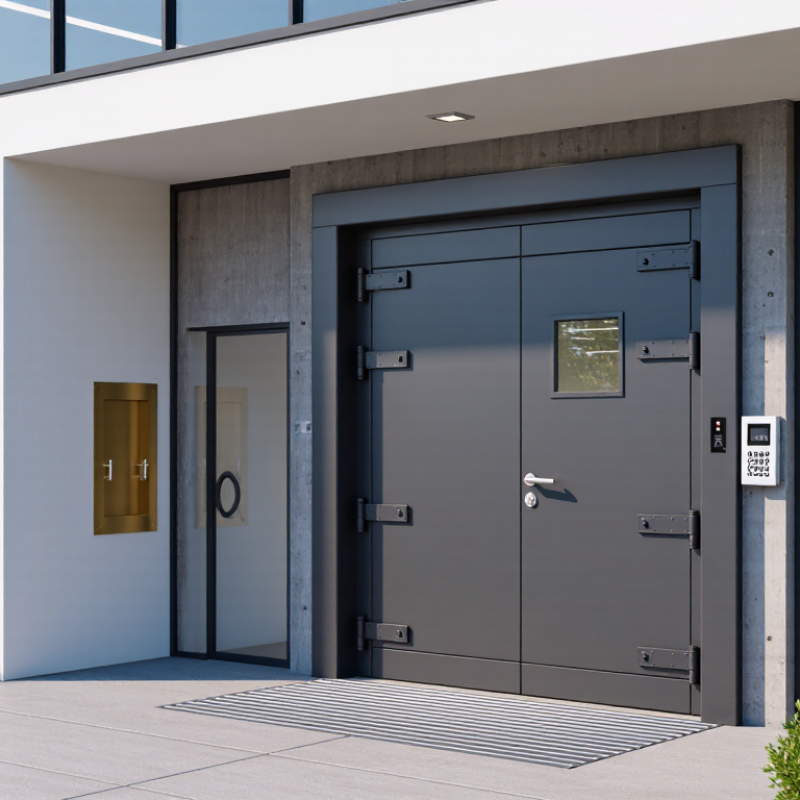
Every business faces a different security pattern. A small office may need a reinforced steel door with a reliable access-control reader. Steel offers strength, privacy, and resistance to frequent use. However, it can feel excessive for a welcoming reception area.
Retail stores often choose aluminum-framed glass doors. They improve visibility while supporting controlled entry. Laminated safety glass can help reduce shattering risks. Staff should still inspect hinges, locks, and closing speed each day. A strong panel is useless when the frame moves.
Warehouses and service entrances usually benefit from rolling security shutters or heavy-duty sectional doors. These options protect wide openings and handle repeated deliveries. Fire-rated doors may suit workshops, kitchens, and storage areas where compartment protection matters. Their rating must match the building plan and local requirements.
Busy facilities may need doors with panic hardware, timed access, or automatic closing systems. Schools, clinics, and offices require simple evacuation routes, not complicated barriers. From practical site assessments, poor installation causes many failures. Buyers should check maintenance access, spare parts, drainage, lighting, and emergency operation before choosing a door. The most expensive option is not always the most dependable. A quieter door may also be better for staff comfort, although its security performance needs careful verification.
Material choice affects more than appearance. Steel offers high impact resistance, dimensional stability, and predictable performance under heavy use. World Steel Association reports that steel remains one of the world’s most recycled materials, supporting a practical sustainability argument. However, thicker steel is not automatically safer. Door gauge, internal reinforcement, hinge design, and frame anchoring must work together.
Test the whole assembly. A commercial door should have documented performance for forced-entry resistance, fire exposure, corrosion, and repeated operation. The National Fire Protection Association’s Fire Loss in the United States During 2023 report recorded approximately 1.5 million fires. This figure reinforces why fire-rated doors, approved hardware, and compatible frames deserve close attention.
A fire label on the slab alone is insufficient. The complete assembly must match the tested configuration.
Construction details often decide real-world reliability. Look for continuous hinges or protected heavy-duty hinges, reinforced lock areas, adjustable closers, and frames secured to structural material. Stainless steel may suit damp loading areas, while galvanized steel can provide a sensible balance for many interior applications. DOE guidance also notes that doors and windows influence building-envelope energy performance, so seals and thresholds matter. Small gaps become noticeable with dust, noise, and drafts. I would still question every rating copied from a brochure. Ask for test standards, maintenance requirements, and installation records. A strong door poorly fitted is only an expensive weakness.
Top Security Doors for Business: What Should Buyers Know?
A strong security door starts with the correct rating, not its appearance. EN 1627 classifies doors from RC1 to RC6, based on resistance to forced entry. Many offices may consider RC3 for controlled commercial areas, while higher-risk sites may require RC4 or above. ANSI/BHMA Grade 1 locks are designed for demanding commercial use. Still, ratings do not measure every installation weakness. A perfect door can fail beside a fragile frame.
Lock selection should match the access policy. Mechanical locks remain useful during power failures, but electronic systems provide audit trails and faster credential changes. The National Institute of Standards and Technology recommends phishing-resistant authentication for higher-risk access. Its guidance also supports separate credentials and stronger verification methods. The 2024 Data Breach Investigations Report found that human involvement appeared in 68% of breaches. A misplaced access card can matter as much as a weak lock.
Tips: Check the frame, hinges, strike plate, and surrounding wall together. Ask for independent test certificates, not only sales claims. Confirm whether the reader works during network or power loss. Keep emergency override procedures documented and tested. Access logs should be reviewed regularly. This step is often neglected. I would also test the door after installation, because field performance rarely matches laboratory conditions perfectly. Include staff training, visitor controls, and scheduled maintenance in the purchasing plan.
A practical comparison of common commercial security-door solutions. Required performance depends on the building use, threat profile, fire strategy, accessibility requirements, and applicable local codes.
| Door Type | Typical Security Characteristics | Relevant Rating or Test Area | Lock and Hardware Options | Access Control Compatibility | Common Business Uses | Key Buyer Checks |
|---|---|---|---|---|---|---|
| Steel Security Door | Steel skins and reinforced cores provide strong resistance to forced entry when the frame, hinges, anchors, and hardware are correctly specified. |
Rating varies by tested assembly Look for documented forced-entry, impact, and cycle testing where required. |
|
Suitable for card readers, keypad locks, electric strikes, electromagnetic locks, and monitored door contacts, subject to life-safety requirements. | Offices, warehouses, service corridors, utility rooms, and restricted internal areas. | Verify corrosion protection, frame anchoring, clear opening, handing, and hardware compatibility. |
| Ballistic-Resistant Door | Designed to resist specified ammunition threats for a defined protection level. The complete door assembly must be evaluated, not just the panel. |
Threat-level rating Confirm the tested ammunition, firearm type, number of impacts, and test standard. |
Reinforced locks, protected hinges, continuous hinge systems, and hardware rated for the door’s weight. | Access-control hardware must maintain the required protective performance and must not create an unprotected area around the lock or reader. | Financial service areas, public safety facilities, critical infrastructure, and high-risk reception points. | Request test documentation for the full assembly, glazing, frame, seams, and hardware. |
| Forced-Entry Security Door | Focuses on resisting attacks such as prying, levering, impact, drilling, and manipulation through reinforced construction and protected hardware. |
Resistance class depends on the standard Confirm whether the rating covers the door, frame, lock, and installation method together. |
High-security cylinders, restricted key systems, deadbolts, multi-point locks, security escutcheons, and anti-pry detailing. | Can support credential readers and electronically controlled locks, but emergency release and fail-safe or fail-secure behavior must be assessed. | Server rooms, records storage, pharmacies, cash-handling rooms, and exterior service entrances. | Assess attack delay, key-control procedures, rekeying needs, and the security of adjacent walls. |
| Fire-Rated Security Door | Combines security features with resistance to the spread of fire and smoke for a specified duration when installed as a listed assembly. |
30, 60, 90, or 120 minutes The required duration depends on the wall, occupancy, and local building regulations. |
Listed fire-rated closers, latches, hinges, panic devices, and approved electronic locking hardware. | Access control is possible, but components must be approved for the fire-rated assembly and coordinated with alarm and egress systems. | Stairwells, plant rooms, corridors, storage areas, and compartment boundaries. | Confirm the label, glazing limits, self-closing function, positive latching, and inspection requirements. |
| Bullet- and Impact-Resistant Glass Door | Uses tested glazing and reinforced framing to address ballistic or impact threats while maintaining visibility and daylight. |
Glazing threat or impact rating The glass, frame, door leaf, joints, and hardware should be assessed as a complete system. |
Heavy-duty pivots or hinges, protected locks, reinforced stiles, and compatible closers. | Supports badge readers, intercom release, biometric readers, and video verification when the wiring and mounting do not weaken the assembly. | Reception areas, security vestibules, public-facing counters, and controlled visitor entrances. | Check optical clarity, replacement procedures, frame anchoring, weight capacity, and emergency egress. |
| Roll-Up Security Door or Grille | Provides controlled separation for openings that need frequent operation, visibility, or a compact overhead design. |
Opening-specific performance Review wind, cycle, impact, forced-entry, and fire performance where applicable. |
Floor locks, slide bolts, motor brakes, interlocks, tamper-resistant guides, and monitored position switches. | Compatible with keypads, card readers, vehicle access systems, timers, safety edges, and building management systems. | Loading bays, retail shutters, parking facilities, service counters, and warehouse openings. | Confirm headroom, guide strength, obstacle detection, manual override, and power-failure operation. |
| Blast-Resistant Door | Engineered to reduce hazards from a specified blast overpressure and impulse while managing door movement and fragmentation. |
Blast pressure and impulse rating Performance is project-specific and depends on the hazard scenario and installation. |
Heavy-duty locking bars, reinforced frames, blast-rated hinges, compression seals, and controlled latching mechanisms. | Electronic access control may be used, but the locking arrangement, power supply, release logic, and remote operation require specialist design. | Industrial facilities, critical infrastructure, laboratories, and designated high-hazard areas. | Require a professional hazard assessment, structural coordination, pressure data, and documented installation details. |
Buyer note: Security ratings are not interchangeable. A fire rating addresses fire exposure, a ballistic rating addresses a defined ammunition threat, and a forced-entry rating addresses specified attack methods and duration. Always verify the applicable standard, test scope, installation requirements, emergency-egress rules, accessibility provisions, and local authority approvals before purchasing.
A business security door must protect people, not only property. Fire performance deserves equal attention to steel thickness and lock strength. Buyers should check the tested fire rating, smoke-control features, and approved hardware before ordering. Requirements vary by building type and location, so local fire authorities should confirm the specification.
A compliant door usually needs a self-closing device, suitable hinges, correct frame protection, and clearly documented testing. The surrounding wall must also support the rated assembly. A strong door can still fail if installers leave gaps around the frame. On busy premises, the door should open safely along the required escape route and remain usable during an emergency. Accessibility rules may also affect opening force, thresholds, and vision panels. Small details matter.
Tips: Request test certificates before payment. Confirm that the rating covers the complete door set, not just the slab. Measure the opening twice, including wall thickness and floor level. Use a qualified installer familiar with fire-rated assemblies. Ask for written maintenance instructions. Monthly checks can reveal a weak closer, damaged seal, or loose hinge. Do not repaint, drill, or replace hardware without approval; those changes may affect certification. One practical mistake is choosing a higher rating without checking the wall. More protection is not always better if the whole assembly remains unapproved.
Choosing a security door for a business requires more than comparing the purchase price. A low quote can hide installation changes, unusual frame sizes, or weak hardware. Ask for a complete cost breakdown. It should include delivery, fitting, access-control preparation, and future replacement parts. Get it in writing.
Maintenance affects daily operating costs. Inspect hinges, closers, locks, seals, and viewing panels during regular service visits. A door exposed to rain, dust, or heavy trolley traffic may need attention sooner than expected. Easy access to adjustable parts can reduce labor time. That matters.
Long-term value depends on use, not appearance alone. A busy warehouse needs a different specification from a quiet office entrance. Check the door’s tested performance, cycle rating, corrosion resistance, and warranty conditions. Independent test evidence is more useful than broad marketing claims. Ask who performs repairs and how quickly parts are available.
Do not ignore staff feedback. Employees notice dragging doors, stiff handles, and closing noise before managers do. These small faults can become safety or access problems. In one assessment, a durable door still performed poorly because its closer was incorrectly adjusted. The product was not the only issue. Installation quality matters.
A fair comparison should estimate five-year ownership costs, including inspections, repairs, energy loss, and downtime. Exact forecasts are difficult. That uncertainty deserves attention. Choose a specification that fits the building, traffic level, and maintenance capacity, rather than paying extra for features nobody will use.
How to compare installed cost, maintenance, and long-term value
This planning comparison uses typical commercial-market estimates in USD for common security-door categories. Ten-year ownership cost combines the initial installed price with ten years of routine maintenance. Actual costs vary by opening size, hardware, access-control requirements, labor rates, security rating, and site conditions.
WhatsApp us