What Are the Top Intelligent Pole Manufacturers in China?
China’s Intelligent Pole sector is moving beyond street lighting. Today’s platforms may combine LED fixtures, cameras, environmental sensors, public Wi-Fi, and emergency call devices on one structure. The challenge is integration. A pole outside a transport hub may need different equipment from one beside a quiet residential road. Kevin Ashton, who helped popularize the Internet of Things concept, put the wider opportunity this way: “The Internet of Things has the potential to change the world, just as the Internet did. Maybe even more so.” Intelligent poles bring that connected-world vision into streets, where reliability and maintenance matter as much as technical specifications.
This guide examines leading Chinese manufacturers through practical criteria: product range, system integration, deployment experience, customization, and after-sales support. A polished product image is not proof of dependable field performance. Buyers should ask for project references, component details, warranty terms, and evidence that different devices work together. Look closely at the cabinet, too; heat, dust, and crowded wiring can expose weaknesses that a showroom cannot. Rankings also have limits. Public information varies, and a strong supplier for one city may not suit another. That deserves reflection. The companies discussed here offer useful starting points, not a substitute for checking project requirements and verifying claims directly.
What Is an Intelligent Pole and How Does It Work?
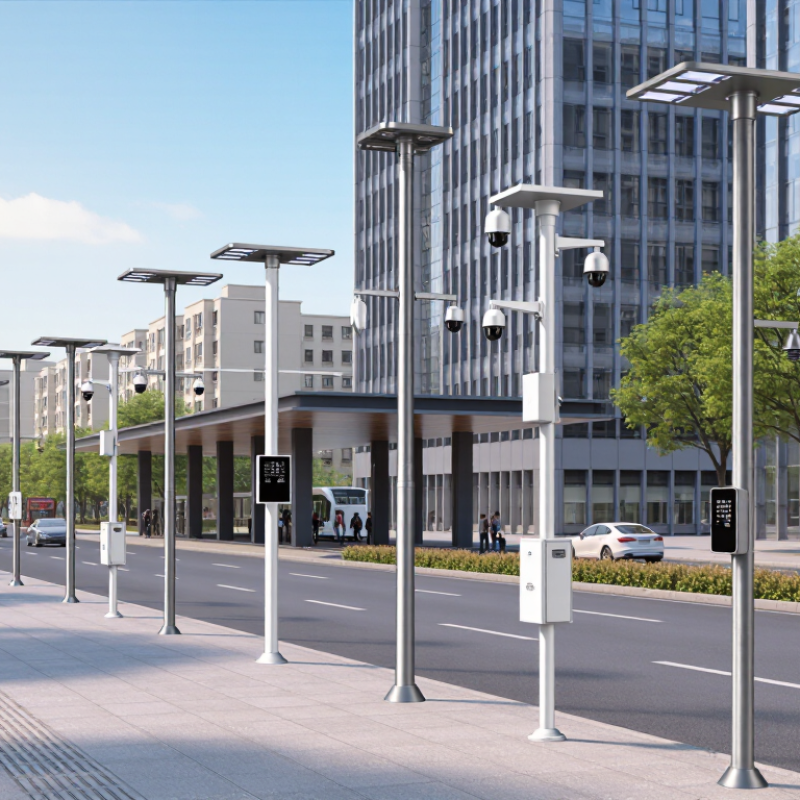
An intelligent pole combines street lighting with connected equipment on one structure. It may carry LED luminaires, environmental sensors, traffic detectors, public Wi-Fi, and safety cameras. Exact equipment varies by project.
Small but important.
A controller gathers sensor readings and adjusts lighting or sends data to a management platform. At dusk, for example, ambient-light readings can trigger brighter lamps as pedestrians approach. This can save energy while keeping paths visible.
Power and network connections run through the pole, often using modular compartments for easier servicing. Some functions operate locally, so lights can respond even if the network drops. Others rely on a central platform for monitoring, alerts, and coordinated control.
No magic here.
Good performance depends on sensor placement, weatherproofing, heat management, and reliable software updates. A poorly planned pole can become crowded, difficult to repair, or incompatible with future devices. When comparing manufacturers in China, buyers should examine tested configurations, maintenance access, and data-interface documentation—not just feature lists. Specifications still need to match the street.
How Are Intelligent Pole Manufacturers in China Evaluated?
How should buyers evaluate intelligent pole manufacturers in China? Start with evidence, not showroom claims. The ITU-led U4SSC KPI framework lists 91 indicators for smart sustainable cities, including 54 core indicators. This gives buyers a useful lens: ask how a pole’s lighting, sensing, connectivity, and energy data support measurable city outcomes. Request test reports, component specifications, and sample data exports. Numbers matter.
Check outdoor durability and integration in real conditions. Review ingress and impact protection ratings, corrosion resistance, thermal performance, and documented test methods. Ask whether lighting controls and communication modules can be replaced separately; a sealed, one-piece design may raise maintenance costs. Compare energy use at defined dimming schedules, not only at full brightness. Also test interfaces with the intended network platform, and confirm software update and cybersecurity procedures. One pilot site is useful, but it cannot prove performance across every climate.
Tips: Ask for a pilot with recorded power use, fault alerts, and maintenance time. Set acceptance thresholds before installation. A polished demo can still hide weak support. Check spare-part availability and warranty terms in writing.
Which Companies Are Among China’s Leading Intelligent Pole Manufacturers?
China’s leading intelligent pole manufacturers are usually identified by their engineering capabilities, not by a single product feature. Strong candidates combine pole structures, LED lighting, communication equipment, cameras, sensors, and control software. Their systems should fit real streets, where space, weather, maintenance access, and existing power connections all matter.
Some companies specialize in lighting and pole fabrication, while others focus on telecom infrastructure or smart-city integration. Manufacturers with in-house design and testing can coordinate these parts more effectively. Ask for documented load calculations, corrosion protection details, component specifications, and examples of completed installations. A clear maintenance plan matters too. Small details count.
A useful supplier should explain how devices communicate and what happens when a sensor or network connection fails. Request drawings and verify that the proposed equipment suits local conditions, rather than relying on a polished demonstration. Site visits can reveal practical issues, such as crowded cable compartments or difficult service access. Even experienced firms may have gaps; integration quality deserves careful review.
What Technologies and Services Do These Manufacturers Provide?
Intelligent pole manufacturers combine street lighting with communication, sensing, and public-service equipment. Many provide LED luminaires with dimming controls that adjust brightness by schedule or detected activity. Pole-mounted sensors can track air quality, temperature, noise, or traffic flow. Some systems also support wireless access, camera connections, emergency buttons, and electric-vehicle charging. The exact package depends on the site.
The pole is only part of the system. Manufacturers may design foundations, equipment layouts, power distribution, and network connections for each project. They can also supply management software for monitoring energy use, checking device status, and receiving fault alerts. Useful details include clear installation drawings, compatible interfaces, and a plan for software updates. Small details matter.
After installation, service teams may handle commissioning, maintenance training, and replacement parts. Buyers should ask how sensors are calibrated and how quickly faults can be diagnosed. Data access and retention settings deserve careful review, too. A crowded pole can look impressive but become difficult to maintain. More equipment is not always better. Some projects still struggle with inconsistent interfaces between devices, so compatibility should be tested before full deployment.
What Technologies and Services Do Intelligent Pole Manufacturers in China Provide?
This chart summarizes technology and service categories commonly associated with intelligent poles. It is a representative capability map, not a market-share comparison or a claim about every manufacturer.
A value of 1 indicates that the category is commonly included or offered as an option in intelligent pole projects; it does not indicate adoption rate.
How Do Buyers Compare Intelligent Pole Suppliers?
When comparing intelligent pole suppliers, buyers should look beyond the product renderings. Request a bill of materials that identifies the pole, camera mounts, lighting, communication equipment, and control components. Check whether interfaces and data protocols are documented, especially if the system must connect with existing city networks. Details matter.
Ask for structural calculations and test records relevant to wind, corrosion, and the planned equipment load. A coastal installation and an inland street corner face different conditions. Review sample drawings, installation instructions, and commissioning steps. These reveal whether the supplier has considered cable access, maintenance clearance, and safe replacement of modules. A polished brochure cannot answer every field question.
Compare warranties, spare-parts availability, response times, and training—not just the quoted price. Ask who handles software updates and troubleshooting after handover. If possible, speak with a project reference and inspect a completed installation. Not always easy. Supplier comparisons are imperfect: specifications may use different test methods, and low upfront cost can hide service gaps. I would still ask one more question: what happens when a component fails on a rainy night? A clear, documented answer is useful evidence of operational experience.
