
Top Menstrual Cup Brands in China for Global Buyers
Choosing reliable Menstrual Cup Brands in China requires more than comparing prices or glossy product photos. Global buyers need evidence of material quality, production consistency, user comfort, and responsible communication. A soft medical-grade silicone cup may look simple, yet its rim strength, air holes, stem finish, and measured capacity affect daily use. Small details matter. A rough edge can reduce comfort. An unclear size chart can create costly returns.
Professor Penelope Phillips-Howard, a leading menstrual health researcher, has stated, “Menstrual cups are a safe option for managing menstruation.” Her research supports careful evaluation, not careless promotion. This distinction matters when reviewing Chinese suppliers. Buyers should examine product samples, factory experience, quality-control records, packaging accuracy, and independent test documentation. They should also confirm whether product claims match available evidence and local market requirements. A supplier’s catalogue is only a starting point.
This guide introduces notable Menstrual Cup Brands and manufacturers serving international buyers. It considers silicone consistency, mould precision, colour stability, private-label support, minimum order quantities, and communication quality. It also looks at practical issues, such as whether a sample arrives with clear instructions and clean packaging. No ranking is perfect. Supplier information can change. Some impressive websites reveal limited manufacturing depth. Some quieter factories may offer stronger technical support. That uncertainty deserves attention. Buyers should request current documentation, inspect samples, and test products with suitable users before placing large orders. Good purchasing decisions combine expert evidence, direct experience, and honest reflection.
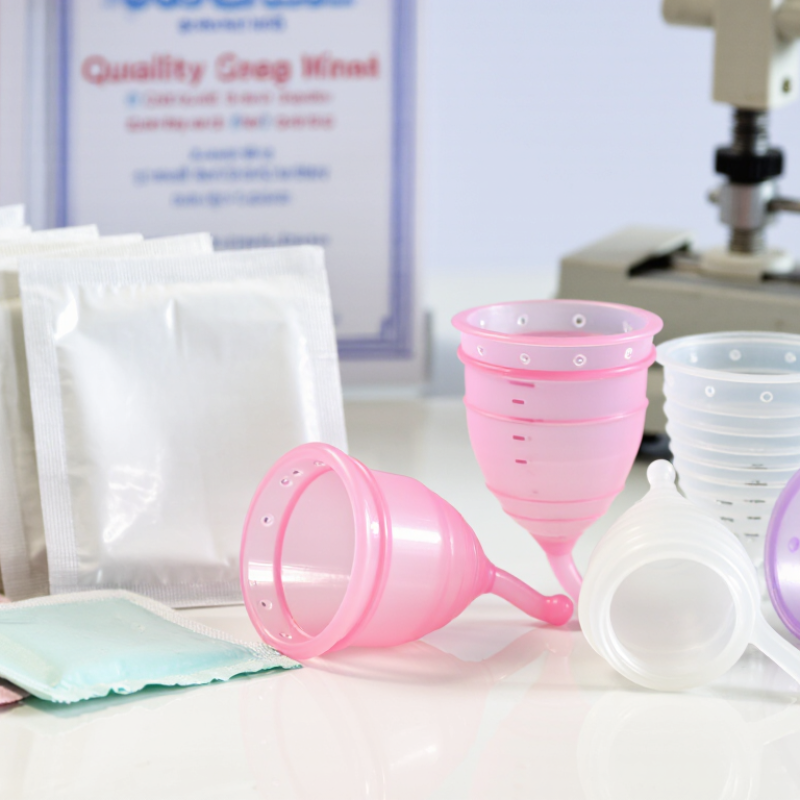
China’s Leading Menstrual Cup Brands for International Buyers
China’s leading menstrual cup suppliers serve international buyers through OEM, ODM, and ready-to-label programs. Many operate specialized molding facilities with clean assembly areas and documented quality checks. Buyers can compare medical-grade silicone, TPE, firmness, capacity, and size options. A cup should feel flexible, but not collapse easily during movement.
Production details matter. Ask for silicone traceability, mold maintenance records, batch inspection reports, and packaging specifications. Reliable manufacturers can explain rim thickness, air-hole placement, pull-stem design, and sterilization instructions without vague promises. Independent testing may cover material safety, biocompatibility, odor, tensile strength, and color migration. Requirements differ between destination markets.
In factory discussions, sample approval should come before large-volume production. Check the cup under warm water, inspect the rim, and test opening after folding. A small defect can affect comfort or sealing. No supplier is perfect. Even an experienced buyer may overlook carton compression during long-distance shipping. Clear drawings, tolerance limits, and retained samples reduce that risk. International buyers should also verify labeling, language, instructions, recycling claims, and after-sales procedures with qualified local advisers.
| Evaluation Dimension | Buyer-Relevant Product Data | Typical Market Benchmark | Recommended Verification for Global Buyers |
|---|---|---|---|
| Primary Material | Medical-grade silicone is the most common material for reusable menstrual cups. Thermoplastic elastomer may also be used in some product designs. | Silicone Latex-free options Reusable construction | Request material specifications, supplier declarations, batch traceability, and independent testing for skin-contact safety and restricted substances. |
| Product Capacity | Capacity is normally measured in millilitres and may be stated as total capacity or recommended usable capacity. | Common cup capacities are approximately 20–40 mL, depending on size and shape. | Confirm whether the stated capacity includes the air holes, stem, or overflow margin. Ask for a technical drawing and measured capacity report. |
| Size Range | Size selection is generally based on user age, cervix height, flow level, pelvic-floor condition, and previous vaginal birth rather than age alone. | Small Medium Large | Review diameter, length, body shape, rim diameter, and stem length separately. Avoid relying only on labels such as “small” or “large.” |
| Dimensions | Important dimensions include overall length, cup length, diameter, rim diameter, wall thickness, and stem length. | Many adult models fall broadly within approximately 40–70 mm in total length, but dimensions vary significantly by design. | Require a dimensioned product drawing with tolerances. Confirm whether measurements are taken before or after sterilization and packaging. |
| Firmness Options | Firmness affects opening performance, comfort, leak resistance, and suitability for different pelvic-floor conditions. | Soft Medium Firm | Ask for a documented hardness or compression test method. “Soft” and “firm” are not internationally standardized marketing terms. |
| Air-Hole Design | Air holes help release the seal and support removal. Hole position, diameter, and finishing quality influence cleaning and usability. | Multiple small air holes are common; hole edges should be smooth and free from flash or burrs. | Inspect samples under magnification and verify hole consistency, smoothness, cleanliness, and resistance to blockage during use. |
| Stem Design | Common designs include straight stems, ring stems, ball stems, and shorter or trimmable stems. | Standard stem Ring stem Trimmable stem | Confirm stem attachment strength, edge smoothness, trim instructions, and compatibility with the cup’s intended user group. |
| Product Finish | A smooth, non-porous surface generally supports easier cleaning and reduces residue retention compared with rough or damaged surfaces. | Uniform color, smooth edges, consistent wall thickness, and no visible particles, cracks, bubbles, or molding defects. | Define acceptable quality limits for surface marks, color variation, flash, deformation, odor, and contamination before mass production. |
| Color and Customization | Customization may include color matching, embossed measurement markings, logo placement, packaging artwork, and instruction materials. | Custom colors Embossed markings Private packaging | Approve color samples and artwork proofs. Request confirmation that pigments, inks, and adhesives are suitable for the intended product contact and packaging use. |
| Cleaning and Care Guidance | Reusable cups normally require washing between uses and sanitization according to the supplied instructions. Overheating or unsuitable chemicals may damage the material. | Packaging commonly includes cleaning, insertion, removal, storage, and replacement guidance. | Review multilingual instructions for accuracy, recommended cleaning methods, boiling or sanitizing limits, storage conditions, and warning statements. |
| Packaging Formats | Available formats may include individual cartons, reusable storage bags, paper inserts, barcode labels, and multipacks. | Retail carton Storage pouch Multipack | Check packaging dimensions, drop resistance, moisture protection, recycling marks, language requirements, and barcode compatibility with the destination market. |
| Quality Management | A documented quality system should cover incoming materials, molding, trimming, cleaning, inspection, packing, nonconforming products, and corrective actions. | International buyers commonly request quality-system documentation such as ISO 9001 or ISO 13485 where relevant to the product and market. | Verify the certificate scope, issuing body, validity period, manufacturing site, inspection records, and lot-release procedures. |
| Material and Safety Testing | Testing may address cytotoxicity, irritation, sensitization, chemical composition, extractables, odor, and restricted substances, depending on destination-market requirements. | Biocompatibility evidence Chemical testing Restricted-substance screening | Use laboratories accepted by the target market or importing authority. Confirm that test samples, materials, colors, and production sites match the commercial product. |
| Regulatory Documentation | Regulatory classification and documentation requirements differ by country or region. A certificate used in one market may not be sufficient for another. | Common documentation may include declarations, technical files, risk assessments, test reports, labeling files, and product registration materials where applicable. | Determine requirements for each destination before placing an order. Do not treat CE, FDA, or other market references as universally interchangeable approvals. |
| Traceability | Traceability should connect finished products to material batches, production dates, inspection records, packaging lots, and shipment records. | Lot coding Batch records Retention samples | Confirm lot-code format, retention period, complaint handling, recall procedures, and the supplier’s ability to provide production records. |
| Order Planning | Commercial terms vary according to mold status, customization, packaging complexity, material color, testing requirements, and production schedule. | MOQ, tooling charges, sample fees, and lead times should be treated as quotation-specific rather than universal market standards. | Request a written quotation covering MOQ, tooling ownership, sample approval, production lead time, payment terms, inspection terms, and Incoterms. |
| Pre-Shipment Inspection | Inspection can cover quantity, dimensions, appearance, color, packaging, labeling, workmanship, and functional characteristics. | Sampling plans are often based on an agreed AQL standard, with critical, major, and minor defect limits defined in advance. | Approve a golden sample and inspection checklist before production. Use an independent inspection service when shipment risk or order value justifies it. |
| Suitable Buyer Segments | Potential buyers include distributors, pharmacy chains, e-commerce retailers, menstrual-health organizations, private-label importers, and institutional programs. | Each segment may require different packaging, documentation, educational content, price positioning, and market authorization. | Match the product specification and compliance file to the final sales channel and intended user population in the destination country. |