A Pvdf Air Dome can cover a sports court, storage yard, or event space without columns interrupting the interior. But the name alone says little about quality. Buyers should confirm whether the supplier uses PVDF-coated polyester fabric, and request clear specifications for membrane weight, coating, seams, and expected service life.
The stakes are practical. UNEP and the Global Alliance for Buildings and Construction reported that buildings accounted for 32% of global energy demand and 34% of energy-related CO₂ emissions in 2023. Those figures do not measure air domes specifically, but they reinforce the value of checking insulation, lighting, and operating requirements before purchase. Small details matter. Ask how blowers are backed up, how doors seal, and which wind and snow loads the design can withstand.
This guide compares seven suppliers through product documentation, project experience, customization, installation support, and after-sales service. Look for test records, warranty terms, maintenance guidance, and references for structures in similar climates. A low quote may exclude foundations, transport, or commissioning. Supplier rankings are never universal; project location and engineering review can change the result. Some published specifications are incomplete, so buyers should verify claims directly before signing.
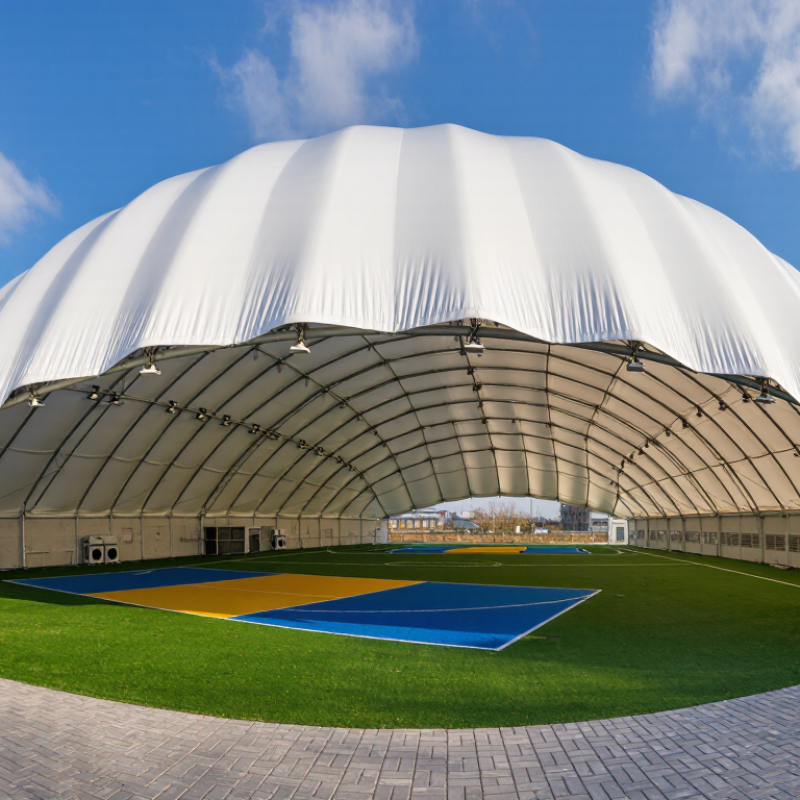
PVDF air domes are usually fabric systems, not solid plastic shells. PVDF often serves as a protective surface finish on coated polyester; the woven fabric carries tension, while cables, anchors, and continuous air pressure help maintain the shape. Dome designs may use a single membrane or an insulated double layer. The right choice depends on climate, span, use, and maintenance access. A finish can resist weathering, but it cannot compensate for weak seams or poor anchoring.
Tips: Ask whether PVDF is the coating or the structural material. Request fabric weight, seam-strength results, UV-aging data, and cleaning guidance. Check how the supplier manages condensation and backup power. Small details matter.
These domes commonly cover sports courts, event venues, and storage areas. Their clear spans create open interiors, but fans must run reliably, and doors need pressure-conscious design. The International Energy Agency’s Buildings – Tracking Clean Energy Progress 2023 reports that buildings account for about 30% of global final energy consumption. That figure is not specific to air domes, yet it underlines why fan use and insulation deserve attention. A practical comparison should include operating energy, not just purchase price. Suppliers’ performance claims also need scrutiny; the site conditions may tell a different story.
When evaluating PVDF air dome suppliers worldwide, verify engineering before comparing prices. Request project-specific wind and snow-load calculations, membrane tensile and tear data, seam-weld test results, and documented PVDF coating specifications. Check that testing methods and stated fire performance match the project’s location and use. Ask who handles foundation interfaces, installation supervision, fan commissioning, and maintenance training. A polished brochure is not evidence.
Global delivery also matters. The World Bank’s 2023 Logistics Performance Index assessed 139 economies across six logistics dimensions, including customs and shipment timeliness. Use this as context when checking a supplier’s export experience, packing procedures, spare-parts lead times, and local installation support. UNEP and GlobalABC reported that buildings and construction accounted for 32% of global energy use and 34% of energy-related CO₂ emissions in 2023. For an air-supported structure, request measured fan power and expected operating hours, rather than broad efficiency claims. No checklist catches everything.
Tips: Ask for two comparable, completed-project references. Speak with the facility operators, not only the sales team. Request inspection photos of membrane seams and fan rooms, plus a clear warranty schedule. Then compare exclusions carefully; they can be easy to miss.
| Evaluation dimension | Suggested weight | What to verify | Evidence to request | Buyer evaluation question |
|---|---|---|---|---|
| 1. Membrane composition and PVDF specification | 20% | Confirm whether PVDF refers to a coating, film, or another component, and identify the base fabric and complete layer construction. Do not assume “PVDF” alone defines the membrane’s performance. | Technical data sheet, material-layer description, coating specification, and traceable test reports for the offered product. | Does the documentation describe the exact membrane proposed for this project, rather than a generic material family? |
| 2. Structural and project-specific engineering | 20% | Check that design calculations address the proposed span, geometry, openings, anchoring, operating pressure, and site conditions. | Project-specific drawings and calculations, design assumptions, and the name and qualifications of the responsible engineering professional. | Will the supplier provide calculations and drawings for the actual site and intended use? |
| 3. Wind, snow, and environmental design inputs | 15% | Verify the design loads and environmental assumptions against the project location and applicable local requirements. Loads and code requirements vary by jurisdiction and site. | Written design criteria, applicable-code references, load calculations, and a clear list of exclusions or operating limits. | Are local wind, snow, temperature, and exposure conditions explicitly included in the design basis? |
| 4. Inflation, controls, and backup systems | 15% | Review the air-handling concept, pressure monitoring, control logic, power requirements, and provisions for equipment failure. | System schematic, equipment schedule, control description, alarms list, and documented backup-power or standby arrangements where required. | Can the supplier explain how pressure is monitored and maintained during normal operation and foreseeable outages? |
| 5. Fire, egress, and life-safety documentation | 10% | Confirm the applicable fire and life-safety requirements with the local authority. Do not treat a test certificate as proof of approval in every country or application. | Relevant material test reports and certificates, emergency-egress details, and a written statement of the standards and test methods used. | Are the supplied documents relevant to the exact product, intended occupancy, and project jurisdiction? |
| 6. Manufacturing quality, delivery, and warranty | 10% | Assess documented inspection and traceability processes, realistic production and shipping schedules, packaging, and clearly defined warranty terms. | Quality-control plan, inspection records or sample reports, delivery schedule, warranty text, and a list of warranty exclusions. | Are acceptance criteria, delivery responsibilities, and remedies for defects clearly stated in the contract? |
| 7. Installation, commissioning, and after-sales support | 10% | Establish who is responsible for installation supervision, commissioning, operator training, spare parts, and technical support after handover. | Installation method statement, commissioning checklist, training plan, service response terms, and spare-parts availability information. | Is support available in the project region, and are response times and responsibilities documented? |
How to use this scorecard: The weights are suggested buyer-side priorities, not an industry standard or supplier ranking. Score each shortlisted supplier against the same evidence requirements, then confirm material suitability, engineering, permitting, and safety requirements with qualified professionals and the relevant local authorities.
Seven PVDF Air Dome Suppliers for Global Buyers should be treated as a shortlist of supplier types, not a fixed ranking. Buyers can compare membrane fabricators, dome engineering firms, turnkey builders, sports-venue specialists, industrial-storage contractors, temporary-event providers, and regional installation teams. Each serves different needs. Some supply coated fabric only; others handle anchoring, blowers, doors, and installation. Ask for project drawings, wind and snow-load calculations, seam-welding details, and references for similar climates. A glossy brochure is not proof of performance.
Energy use deserves early attention. The International Energy Agency’s 2023 Global Status Report for Buildings and Construction estimates that buildings represented 34% of global energy demand and 37% of energy- and process-related carbon dioxide emissions in 2022. These figures cover buildings broadly, not air domes specifically, but they underline the value of checking blower efficiency and operating schedules. Request measured fan power, backup-system details, and maintenance intervals. Inspect a sample seam, too. Small detail, real consequences. PVDF coating alone does not guarantee a long service life; fabric construction, fabrication quality, and exposure conditions matter. Suppliers may provide different test methods, which makes direct comparison imperfect. Record those differences instead of assuming every quoted lifespan means the same thing.
Choosing a PVDF air dome supplier is less about brochure size than evidence. Ask for membrane specifications, seam-welding procedures, and examples of projects in similar climates. Show the test reports. Review whether the proposed design accounts for local wind, snow, drainage, and foundation conditions. A large span on paper may still need careful site adjustments.
Compare certifications by scope, date, and issuing body; a logo alone proves little. Ask whether quality records cover fabrication and whether test reports apply to the exact membrane being quoted. These are not interchangeable. Check how the supplier documents inspections, material batches, and design revisions. Details can get missed, even in a polished proposal.
Project support should be equally concrete. Clarify who coordinates installation, trains operators, and responds when pressure readings change or a door seal wears. Request a maintenance schedule with inspection intervals and spare-part guidance. No supplier can remove every site uncertainty, and schedules sometimes shift. That is worth discussing before signing, not after the equipment arrives. Compare response times and named responsibilities, not just broad promises of after-sales service.
Shortlist PVDF air dome suppliers by matching their experience to your project, not by comparing prices alone. Ask for drawings showing the dome span, entrance layout, anchoring points, and service areas. Request fabric specifications, including coating type, weight, seam construction, and repair method. Then check that the proposed structure accounts for your site’s wind, snow, temperature, and operating conditions. A generic load statement is not enough; ask how the figures apply to your location.
Paperwork can look convincing. Verify test reports with the issuing laboratory, and confirm that the tested material and assembly match the offered design. Ask for references from projects with similar spans or climates, then speak with the owners about installation delays and maintenance needs. If possible, inspect a completed dome or arrange a factory visit. Check who provides engineering calculations, installation supervision, blower support, and replacement parts after delivery. Get warranty exclusions and response times in writing. One detail is easy to miss: confirm what happens if a blower fails during an occupied event. Supplier answers may remain incomplete, so record open questions and resolve them before signing.
Use these suggested weights to compare suppliers consistently. They are a practical evaluation framework, not survey results or ratings of specific companies.
Prioritize engineering, membrane specifications, and quality control. Verify each supplier’s claims with project documentation, test records, references, and clearly defined contract terms.
WhatsApp us