The 2026 global buying landscape for Feather Flags is becoming more demanding. Buyers now compare fabric quality, wind performance, printing accuracy, and installation speed. A flag may look attractive online, yet fail after several rainy events.
Industry evidence supports this shift. The Outdoor Advertising Association of America reported that U.S. out-of-home advertising revenue reached approximately $9.1 billion in 2023. Its 2024 industry updates also highlighted continued investment in measurable, place-based visibility. Meanwhile, Smithers’ report, The Future of Printed Signage to 2028, identifies digital textile printing and more sustainable production as important signage trends. These findings do not measure Feather Flags directly. That limitation matters.
Small details decide performance.
Marketing expert Seth Godin writes, “People do not buy goods and services. They buy relations, stories, and magic.” For Feather Flags, that principle appears beside roads, entrances, and crowded exhibition halls. A sharp logo, readable lettering, and controlled movement can create recognition within seconds. However, design alone cannot compensate for weak stitching, unsuitable poles, or an unstable base.
This guide examines the top Feather Flags types for global buyers in 2026. It compares teardrop, feather, angled, double-sided, illuminated, recycled-fabric, and custom-height options. Each type serves a different setting. A lightweight base may suit indoor retail use, while a water-filled base offers greater outdoor stability. Local weather still changes the decision. There is no universal best flag. The better choice depends on wind exposure, viewing distance, transport needs, branding rules, and replacement costs.
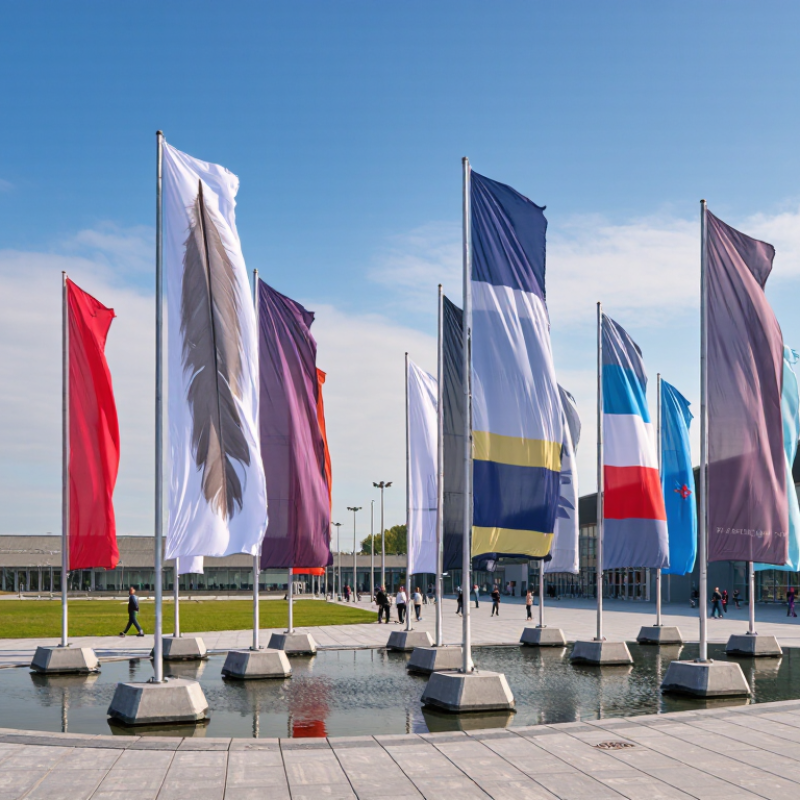
Feather flags are tall, flexible fabric signs designed to attract attention outdoors. Their curved shape resembles a feather, while a lightweight pole keeps the fabric stretched. A sewn sleeve holds the pole, and a ground base supports the complete display.
The flag moves with the wind. This motion catches attention from passing drivers, pedestrians, and event visitors. Common styles include teardrop shapes, flat feather shapes, and double-sided designs. Single-sided fabric is lighter and often brighter from the front. Double-sided fabric improves message visibility from both directions, but it adds weight and may reduce airflow.
Base selection matters more than many buyers expect. A cross base suits hard surfaces when combined with water or sand weights. A spike base works better in firm soil. For indoor floors, a weighted plate is cleaner and safer. Check the pole height, fabric dimensions, stitching, and printed color before ordering. These details affect setup time and service life.
In practical use, feather flags perform best when text is short and placed high enough to read quickly. Small lettering often disappears at a distance. The flag should also face normal pedestrian movement, not simply the strongest wind. The result is rarely perfect on the first setup. Wind, uneven ground, and crowded surroundings can change visibility. Regularly inspect the sleeve, pole joints, and base connection. A damaged fitting may cause the flag to lean or fall.
Feather flags are lightweight fabric banners attached to a flexible, curved pole. The pole keeps the flag raised, while the loose fabric moves in the wind to improve visibility. They are commonly used for entrances, outdoor promotions, events, retail locations, and roadside identification.
The chart compares representative pole heights commonly offered for major feather-flag shapes. Actual dimensions vary by supplier, installation method, wind conditions, and local safety requirements. Taller flags generally provide greater visibility, while compact formats are easier to transport and install.
Data basis: representative height values synthesized from commonly published, brand-neutral outdoor flag specifications; values are not market-share estimates.
In 2026, teardrop feather flags are likely to lead global demand. Their curved shape keeps printed graphics visible, even when the fabric moves. They suit entrances, sidewalks, sports grounds, and outdoor promotions. That versatility matters.
Straight feather flags should remain strong in retail and event markets. Their taller profile gives messages more vertical space, while rectangular flags offer wider branding areas. Double-sided construction may grow among buyers who need readable graphics from both directions. However, extra layers can increase weight, drying time, and shipping costs.
Material choices will influence purchasing decisions more than before. Buyers may prefer recycled polyester, UV-resistant inks, reinforced sleeves, and replaceable poles. From practical installation experience, the base is equally important. A water-filled base works well on paved surfaces, while a ground spike needs firm soil. Wind ratings must be checked carefully.
The forecast is not flawless. Climate, shipping costs, and local advertising rules can quickly change demand. A flag that performs well in a calm European plaza may struggle beside a windy coastal road. Global buyers should request fabric weight, seam details, pole strength, and tested wind guidance before ordering. Small samples reveal more than attractive digital renders. That lesson is easy to overlook.
For global buyers, feather flags differ most in shape, scale, and display hardware. Teardrop flags create a smooth, full-looking silhouette, while feather flags use a curved edge that keeps fabric visible in light wind. Straight or angled flags provide larger printable panels, but they can fold more easily. Shape changes visibility, not just appearance.
Size should follow viewing distance and wind exposure. A 2.5-meter flag suits a shop entrance, while a 4- or 5-meter version works better beside a road or exhibition aisle. The U.S. Outdoor Advertising Association reported US$9.1 billion in out-of-home advertising revenue during 2023. That figure shows why physical visibility still matters. However, bigger is not automatically better. Oversized fabric needs stronger stitching, deeper ground support, and more careful transport.
Display systems also affect reliability. Ground spikes suit grass and compact soil. Cross bases work on hard flooring, but they may need water or sand weights. Rotating poles reduce fabric twisting, although low-cost joints can loosen after repeated setup. In field use, I have found that buyers often measure the flag but overlook the base footprint. That assumption is risky. PQ Media’s Global Out-of-Home Media Forecast emphasizes location and audience context, which also applies here: a compact flag near a crowded doorway can outperform a tall flag hidden behind vehicles. Wind ratings remain difficult to compare because testing methods vary between suppliers.
2026 Top Types of Feather Flags for Global Buyers
Feather flags perform differently because their materials and printing methods match different applications. Knitted polyester is a practical choice for outdoor events, retail entrances, and roadside promotions. Its flexible surface follows the wind and reduces creasing during transport. Dye sublimation prints colors deeply into the fibers, so both sides remain bright and detailed. This method suits logos, gradients, photographs, and multilingual graphics.
For stronger color separation, blockout polyester can prevent unwanted show-through. It works well when the reverse side needs a cleaner appearance. Screen printing may suit simple designs with one or two solid colors. It can provide strong coverage, but complex artwork becomes less efficient. UV printing offers sharp details on some coated fabrics, although folding performance must be tested carefully. A flag that looks excellent indoors may fade faster under intense sunlight. That difference is easy to underestimate.
Tips: Request a fabric sample and a color proof before ordering in volume. Check wind ratings, stitching around the pole sleeve, and the base type for each location. Sand-filled cross bases suit paved areas, while ground spikes fit soil. I have found that buyers often focus on color first, then regret ignoring fabric weight. A lighter flag may travel cheaply, but it can flutter poorly in exposed sites. No material wins every application. The best decision depends on wind, viewing distance, storage, and replacement expectations.
| Feather Flag Type | Recommended Material | Typical Fabric Weight | Suitable Printing Method | Best Applications | Main Advantages | Key Limitations |
|---|---|---|---|---|---|---|
| Single-Sided Feather Flag | Knitted polyester or woven polyester with a light-blocking backing | Approximately 110–140 g/m² | Dye-sublimation printing is generally preferred for full-color graphics and edge-to-edge coverage. | Outdoor retail entrances, roadside advertising, sports events, exhibitions, and temporary promotions. | Lightweight, economical, easy to transport, and highly visible from the printed side. | The reverse side is normally a mirror image and appears less saturated than the front. |
| Double-Sided Feather Flag | Two printed polyester panels separated by an opaque or light-blocking layer | Approximately 130–180 g/m² total construction | Dye-sublimation printing on separate panels; sewn assembly is required. | Two-way pedestrian areas, shopping centers, trade shows, entrance zones, and locations where viewers approach from different directions. | Provides readable graphics on both sides and reduces show-through between designs. | Heavier, more expensive, and usually less permeable to wind than a single-sided flag. |
| Blockout Feather Flag | Blackout polyester or polyester fabric with an integrated opaque middle layer | Approximately 130–170 g/m² | Dye-sublimation printing on the outer polyester surface. | Bright outdoor environments, high-contrast graphics, premium promotions, and applications requiring limited light transmission. | Strong color separation, improved opacity, and reduced visibility of graphics from the opposite side. | Higher material cost and weight; the fabric may dry more slowly after rain. |
| Mesh Feather Flag | Open-weave polyester mesh | Approximately 90–120 g/m² | Dye-sublimation printing designed for mesh; ink coverage should account for open areas. | Coastal sites, exposed roadsides, windy venues, construction areas, and temporary outdoor campaigns. | Allows greater airflow through the fabric and can reduce wind loading compared with solid fabric. | Graphics may look less dense, and small text or fine details can lose clarity through the open weave. |
| Eco-Focused Feather Flag | Recycled polyester fabric with the same general construction as standard flag polyester | Approximately 100–140 g/m² | Dye-sublimation printing using water-based dye systems commonly used for polyester textiles. | Sustainability-led events, public campaigns, environmentally focused retail, and corporate communications. | Can reduce reliance on virgin polyester while maintaining the flexibility needed for flag production. | Environmental benefits depend on certified recycled content, production practices, and end-of-life handling. |
| Indoor Display Feather Flag | Smooth knitted polyester or display-grade polyester | Approximately 100–130 g/m² | Dye-sublimation printing for photographic and gradient graphics; direct-to-fabric printing may also be used. | Indoor exhibitions, shopping malls, conferences, reception areas, showrooms, and retail displays. | Smooth appearance, vivid color reproduction, and a lightweight structure suitable for indoor bases. | Indoor fabrics may not be optimized for prolonged exposure to rain, strong sunlight, or abrasive surfaces. |
| Outdoor Event Feather Flag | Durable knitted polyester with reinforced heading and stitched edges | Approximately 115–140 g/m² | Dye-sublimation printing with outdoor color and fabric testing before large-scale production. | Festivals, sports competitions, fairs, food markets, car parks, and short- to medium-term outdoor events. | Good balance between color quality, flexibility, portability, and production efficiency. | Performance depends on wind conditions, UV exposure, cleaning, storage, and the quality of the pole and base. |
| Premium Woven-Polyester Feather Flag | Tightly woven polyester with a smoother surface and structured hand feel | Approximately 120–160 g/m² | Dye-sublimation printing; specialized textile finishing may be specified for premium visual requirements. | High-end brand-neutral displays, institutional signage, long-running promotions, and demanding photographic graphics. | Smooth surface, good dimensional stability, and sharp reproduction of detailed artwork. | Usually costs more than standard knitted polyester and may require stricter sewing and finishing control. |
| Short-Term Promotional Feather Flag | Lightweight knitted polyester | Approximately 90–115 g/m² | Dye-sublimation printing for efficient production of short-run or campaign-specific graphics. | Product launches, weekend sales, election or public-information campaigns, and one-time events. | Lower shipping weight, fast visual impact, and cost efficiency for temporary use. | Lighter fabric may show wear, fraying, or color change sooner under severe outdoor conditions. |
| Custom Shape Feather Flag | Knitted or woven polyester selected according to the required outline and use environment | Approximately 100–140 g/m² | Dye-sublimation printing followed by computer-controlled cutting and reinforced sewing. | Directional signage, themed events, product silhouettes, sports venues, and distinctive entrance displays. | Unusual outlines can improve recognition and help differentiate the display from standard flag shapes. | Complex shapes may require more fabric planning, specialized patterns, and additional sewing time. |
| Logo and Text Feather Flag | Smooth knitted polyester or tightly woven polyester | Approximately 100–140 g/m² | Dye-sublimation printing is suitable for gradients and multiple colors; screen printing can suit simple, high-volume artwork. | Directional signs, venue identification, membership events, public facilities, and promotional messages with limited artwork. | Clear layouts can remain legible at a distance when text is sufficiently large and contrast is well controlled. | Very small text, thin lines, and low-contrast color combinations can become difficult to read when the flag moves. |
| Reversible Message Feather Flag | Two separately printed polyester faces with an opaque inner layer | Approximately 140–180 g/m² total construction | Separate dye-sublimation printing for each face, followed by alignment and edge sewing. | Different messages on opposite sides, venue wayfinding, queue management, and multi-purpose event signage. | Each side can display an independent design with minimal visual interference. | Requires more material and assembly; alignment and tension must be checked carefully during production. |
Note: Fabric weights, construction details, color fastness, and outdoor performance vary by specification, finishing process, climate, wind exposure, cleaning method, and storage conditions. For international purchasing, request a material sample, printed proof, finished-size drawing, seam specification, and applicable textile test documents before bulk production.
2026 Top Types of Feather Flags for Global Buyers?
What Should Global Buyers Check Before Placing an Order?
Feather flags remain popular for entrances, roadside promotions, exhibitions, and outdoor events. Common types include single-sided, double-sided, teardrop, angled, and rectangular feather flags. Each shape affects visibility, wind movement, printing area, and packing size. A tall curved flag may attract attention, but it can require stronger poles and wider bases. Check the fabric weight, stitching quality, pole material, and printing method before comparing prices. These details often decide whether a flag survives repeated outdoor use.
Ask for exact dimensions, packed weight, artwork requirements, and production tolerances. Screen colors may differ from printed fabric, so request a physical sample when color accuracy matters. Confirm whether the base suits grass, concrete, sand, or indoor flooring. Also check wind guidance, replacement parts, carton protection, and shipping documents. Requirements vary by destination, and assumptions can create expensive delays. I have seen specifications look complete while omitting the pole diameter. That small gap can affect assembly.
Tips: Request photos of finished units, not only digital mockups. Test one sample outdoors for several hours. Inspect seams, corner stress, and pole fit. Confirm the buyer’s responsibility for local import procedures. A low quote is not always economical. Sometimes, the cheaper fabric fades sooner. Keep written approval records for artwork, materials, sizes, and packaging. Even careful buyers miss details when deadlines become tight.
WhatsApp us